Custom AI Backend
We built backend processes to analyze user speech input and generate learning-oriented responses so users could practise spoken English conversationally.
Suspendisse interdum consectetur libero id. Fermentum leo vel orci porta non. Euismod viverra nibh cras pulvinar suspen.
ALULA was an educational technology project developed by my team member and me to explore how AI could support English language learners through interactive speaking practice.
The application was designed around the idea that language learners need opportunities to generate their own spoken English, not just read lessons, repeat scripted lines, or complete written exercises. We built ALULA to let students interact with an AI English tutor, respond to prompts, and practise speaking in a more active way.
This project combined education, user interface design, speech-based interaction, AI-assisted conversation, and web/app development into a working learning product.
The goal of ALULA was to create a learning experience where English learners could practise producing original spoken English in a low-pressure environment.
Traditional language-learning apps often focus on reading, listening, fill-in-the-blank exercises, or repeating prepared phrases. Those approaches can be useful, but they do not always give students enough practice forming their own thoughts and speaking them out loud.
We wanted ALULA to fill that gap by giving learners a conversational AI tutor that could understand student input, respond appropriately, and guide practice across grammar, speaking, conversation, and reading-related activities.
From a development perspective, the project required careful thinking about lesson flow, user interaction, AI-generated responses, speech input, feedback, and how to make the experience approachable for learners.
Technical Implementation
ALULA was built before functional generative AI became widely available. Instead of relying on a modern large language model, my team member and I built a custom backend system to process learner utterances, interpret intent, evaluate language use, and generate responses for conversational English practice.
We built backend processes to analyze user speech input and generate learning-oriented responses so users could practise spoken English conversationally.
TensorFlow was used to train custom models for inference and classification tasks used within the learning flow.
spaCy was used for natural language processing, including grammar-related analysis and intent detection.
The project was Dockerized, separating the web application from backend AI processes for cleaner deployment and organization.
The web portion was developed using the Flask framework, providing the application interface and web-based learning experience.
A companion mobile app was developed for both iOS and Android using Flutter.
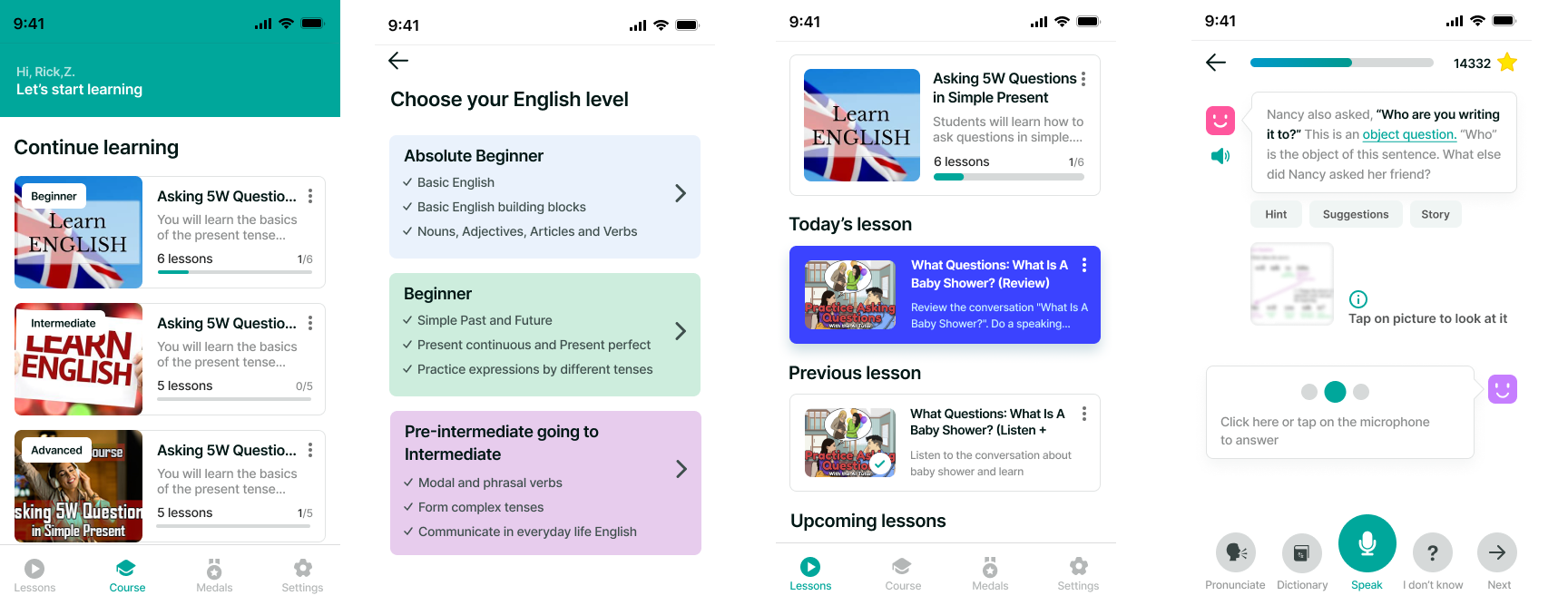
We built ALULA, a web and mobile app that provides an interactive AI tutor experience for English learners to practise speaking and conversation skills in a low-pressure environment, with the following features:
We developed an AI tutor experience that could engage students in guided English practice and respond to learner input.
The app was structured around students generating original English, rather than only selecting answers or repeating fixed sentences.
The AI-based interaction was designed to help learners practise without the nervousness that can come from speaking with another person.
We built the learning experience around spoken language generation so students could practise expressing their own ideas.
The app supported practice topics ranging from simple everyday scenarios to more complex discussion prompts.
The backend AI included grammar analysis and feedback components to help learners understand and improve their language use.
Book a Call
Tell me a little about your project, business, or technical challenge.
I work with Ontario businesses, organizations, and agencies on:
You'll communicate directly with the developer building the project.